TARA
Tibetan Goddess of Compassion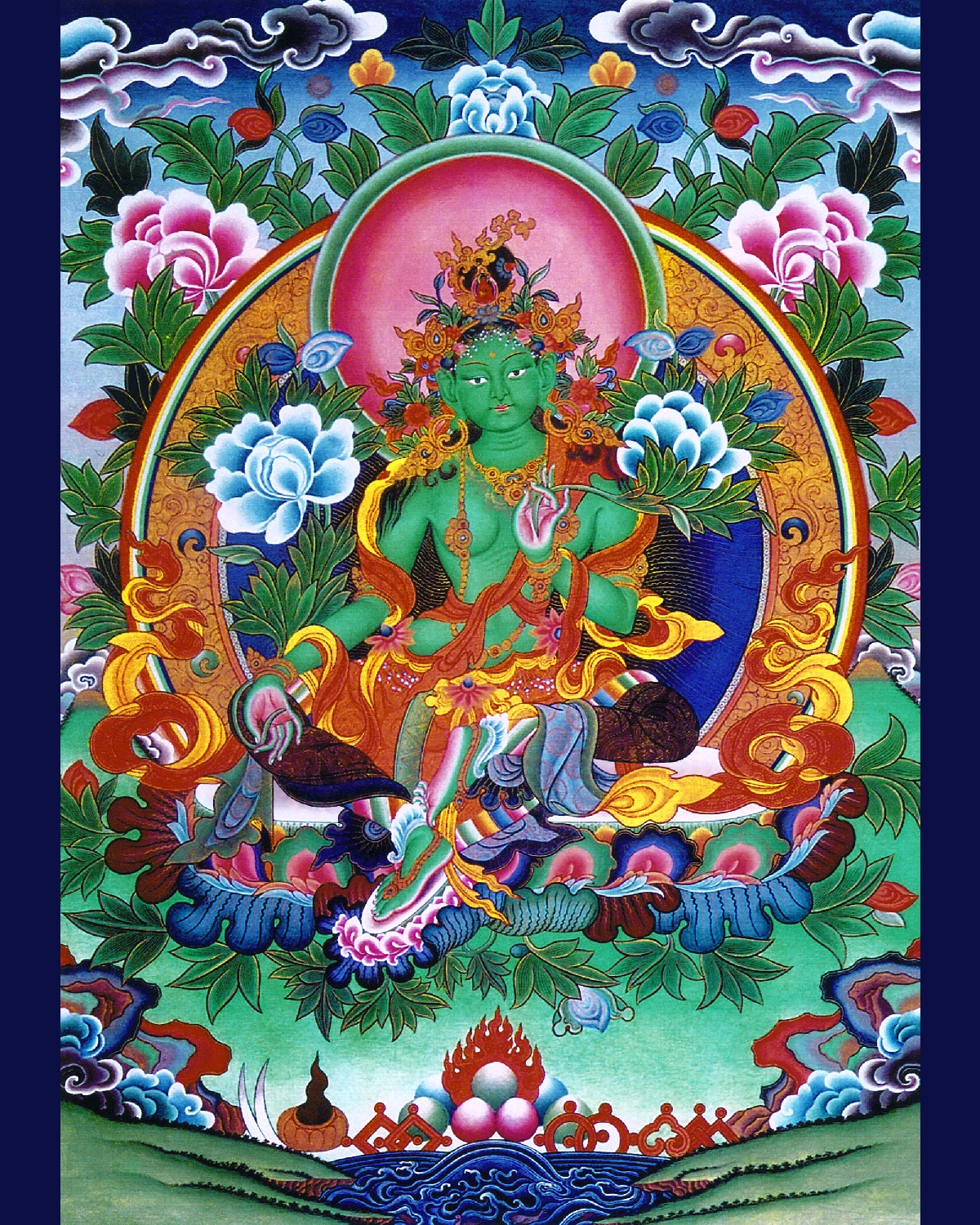
Tibetan Sgrol-ma. Buddhist saviour-goddess with numerous forms, widely popular in Nepal, Tibet, and Mongolia. Tara is the feminine counterpart of the bodhisattva ("Buddha-to-be") Avalokitesvara (meaning one who hears the cries of the world). According to popular belief, Tara came into existence from a tear of Avalokitesvara, which fell to the ground and formed a lake. Out of its waters rose up a lotus, which, on opening, revealed the goddess. Like Avalokitesvara, she is a compassionate, succoring deity who helps men "cross to the other shore." She is the protectress of navigation and earthly travel, as well as of spiritual travel along the path to Enlightenment.
In Tibet she is believed to be incarnate in every pious woman, and the two wives-a Chinese princess and a Nepali princess-of the first Buddhist king of Tibet, Srong-brtsan-sgam-po, were identified with the two major forms of Tara. The White Tara (Sanskrit: Sitatara; Tibetan: Sgrol-dkar) was incarnated as the Chinese princess. She symbolizes purity and is often represented standing at the right hand of her consort, Avalokitesvara, or seated with legs crossed, holding a full-blown lotus. She is generally shown with a third eye. Tara is also sometimes shown with eyes on the soles of her feet and the palms of her hands (then she is called "Tara of the Seven Eyes," a form of the goddess popular in Mongolia).
The Green Tara (Sanskrit: Syamatara; Tibetan: Sgrol-ljang) was believed to be incarnated as the Nepali princess. She is considered by some to be the original Tara and is the female consort or sexual partner of Avalokitesvara. She is generally shown seated on a lotus throne with right leg hanging down, wearing the ornaments of a bodhisattva and holding the closed blue lotus (utpala).
The white and green Taras, with their contrasting symbols of the full-blown and closed lotus, are said to symbolize between them the unending compassion of the deity who labors both day and night to relieve suffering. Under the influence of Tibetan Lamaism the different forms of Tara multiplied to a traditional 108. Tibetan temple banners frequently show 21 different Taras, colored white, red, and yellow, grouped around a central green Tara. The figure of the "self-born" Buddha, Amitabha, is often shown in her headdress, as she, like Avalokitesvara, is considered to be an emanation of Amitabha. In her ferocious, blue form, invoked to destroy enemies, she is known as Ugra-Tara, or Ekajata; as a red goddess of love, Kurukulla; and as a protectress against snake bite, Janguli. The yellow Bhrkuti is an angry Tara, with frowning brows.
There is also a Hindu Tara. Along with Kali She is one of 10 Mahavidyas or Mothers.
 |
A story of light, love and bodacious spiritual adventures. Explore the book Into the Mystic. |
 |
Experience the divinely intoxicating love of the Goddess. Explore the book Soft Moon Shining. |
 |
Learn how to love the Goddess and feel the Goddess loving you in the book Finding God's Love. |
 |
The spiritual path of endless love Bhakti Sutras of Narada. |
 |
The light of non-duality and the path of love according to the life and teachings of Jesus The Mystic Christ. |